The short answer
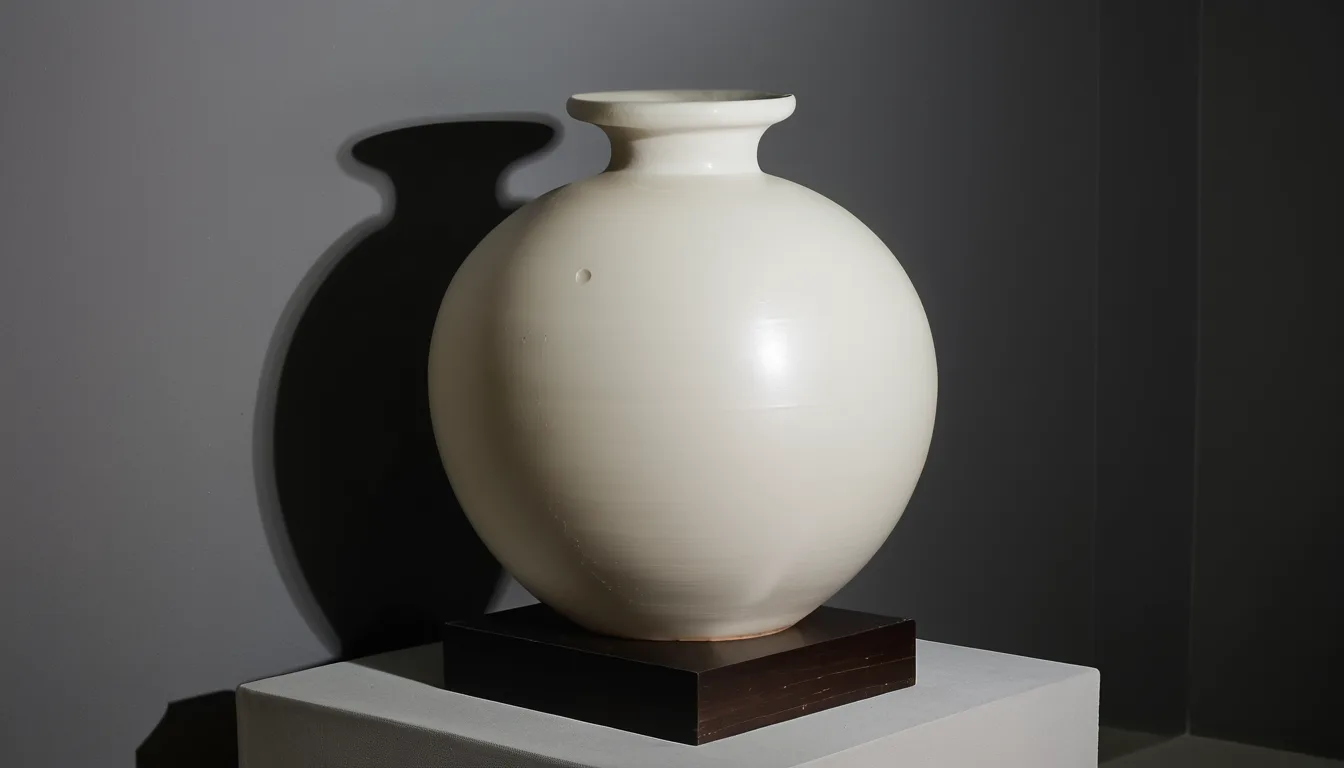
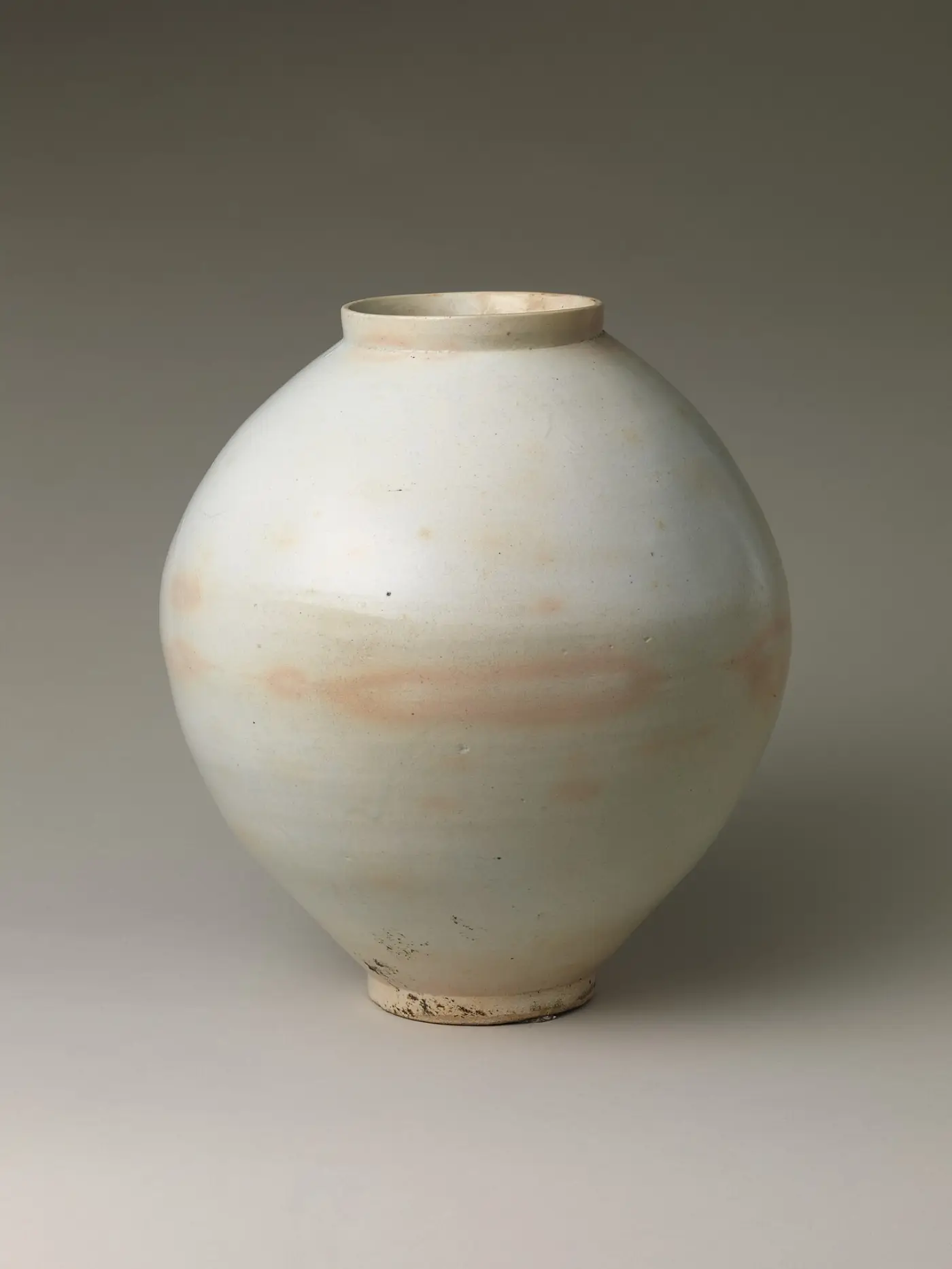
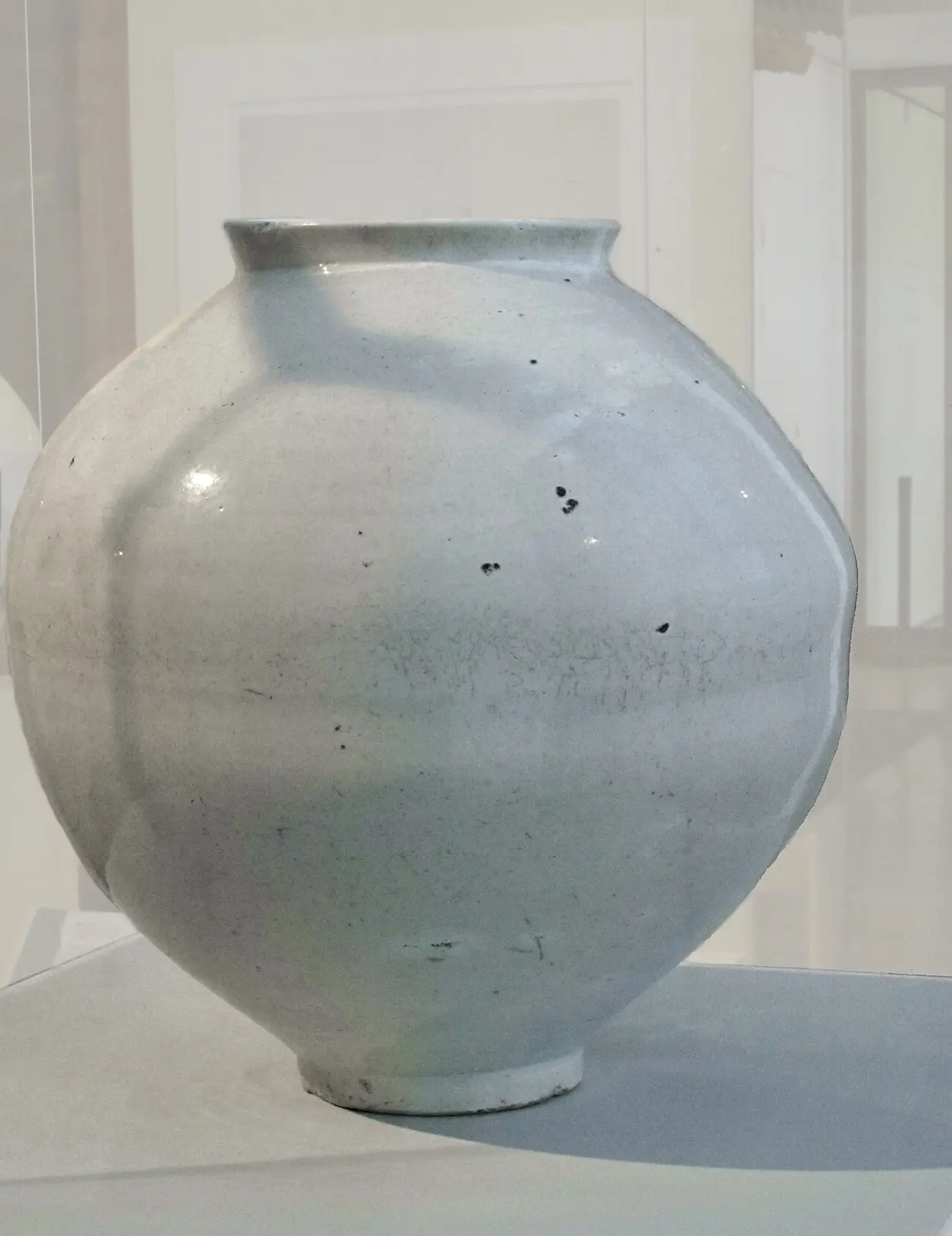
The Encyclopedia of Korean Culture's entry "Moon Jar" says each jar's rounded form varied with the touch of the potter who made it. The entry sums up the moon jar's character as "the charm of an irregular roundness." Wikipedia's "Moon jar" article also mentions the jars' slightly uneven shape.
Asymmetry does not apply to every moon jar, however. The same encyclopedia entry adds that some jars are neatly proportioned. Asymmetry is better understood as a frequent tendency than as a fixed rule. This article covers the joining technique, dates and kilns, National Treasure and Treasure examples, auction records, the origin of the name, comparisons with China and Japan, and the jars made since the 1950s.
Joining the halves: what the encyclopedia and the Korea Heritage Service say
The Encyclopedia of Korean Culture's "Moon Jar" entry describes the method this way: "Because moon jars are so large that they are hard to make on the wheel in one go, in most cases the upper and lower bodies were made separately and joined." In other words, size is the reason for joining. The word "most" matters too. The entry stops short of claiming that every moon jar was made the same way.
The same encyclopedia's "White Porcelain Moon Jar" entry discusses large vessels in general. It says potters usually made the upper part and the lower part, including the foot, separately and then joined them. It traces the reason to the clay. Joseon white clay, it explains, has "low resistance to fire, that is, low refractoriness, so there is a risk that it will not hold up and will collapse after firing." The same sentence notes that the clay is strong and highly plastic.
Read together, the two entries give a two-part explanation for joining. First, the jars were too large to throw on the wheel in a single piece. Second, the white clay did not stand up well to fire. This distinction keeps us from crediting the moon jar's shape to the potter's taste alone. Size and material matter as well.
The Korea Heritage Service's description of the National Treasure white porcelain moon jar gives the same method. It says the jar was "completed by making the upper and lower parts separately and then joining the two, which makes shaping (成型) and firing (燔造) extremely difficult." The "White Porcelain Moon Jar" entry adds that traces of the joint inside the jars confirm this method. Here the written account of the technique matches the evidence on the objects themselves.
The Saongwon branch kilns and Geumsa-ri: late 17th to early 18th century
The "White Porcelain Moon Jar" entry defines the moon jar as a large, milky-white porcelain jar at least 40 cm tall, made in Joseon between the late 17th and early 18th centuries. The Korea Heritage Service narrows the period slightly. It says the jars were made over about a century, especially during the first 50 years of the 18th century. It gives the place of production as "the white porcelain workshop of the Bunwon (分院) branch of the Saongwon (司饔院), the Joseon dynasty's only official kiln (官窯) (Gwangju, Gyeonggi Province)."
The Korea Heritage Service even names the kiln. Some 340 kilns were scattered across the Gwangju area at the time. The agency presumes the jars were made mainly at the Geumsa-ri kiln. The "White Porcelain Moon Jar" entry likewise presumes that the National Treasure moon jar was made at the Saongwon branch in Gwangju. The "Moon Jar" entry presumes that the National Museum of Korea's jar was made at the Bunwon official kiln (分院官窯).
All three accounts use the word "presumed." A sentence in the "White Porcelain Moon Jar" entry explains why: "A considerable number of these moon jars survive in Korea and abroad, but unfortunately not a single piece remains that can be used to establish a chronology." That is why the date of production is given as a broad range rather than a single year. Readers should treat "late 17th to early 18th century" as an estimate, not a fixed date.
Wikipedia differs slightly from the Korean sources. Its "Moon jar" article says moon jars first appeared in the late 17th century and remained popular until the mid-18th century. Its "Joseon white porcelain" article says the branch kiln was established at Bunwon-ri in Gwangju in 1751. The Korean sources center on the early 18th century, while Wikipedia points to the mid-18th century and 1751. The discrepancy is a reminder not to rely on a single source's dates.
National Treasures and Treasures at the Leeum, in Busan and at the National Museum of Korea
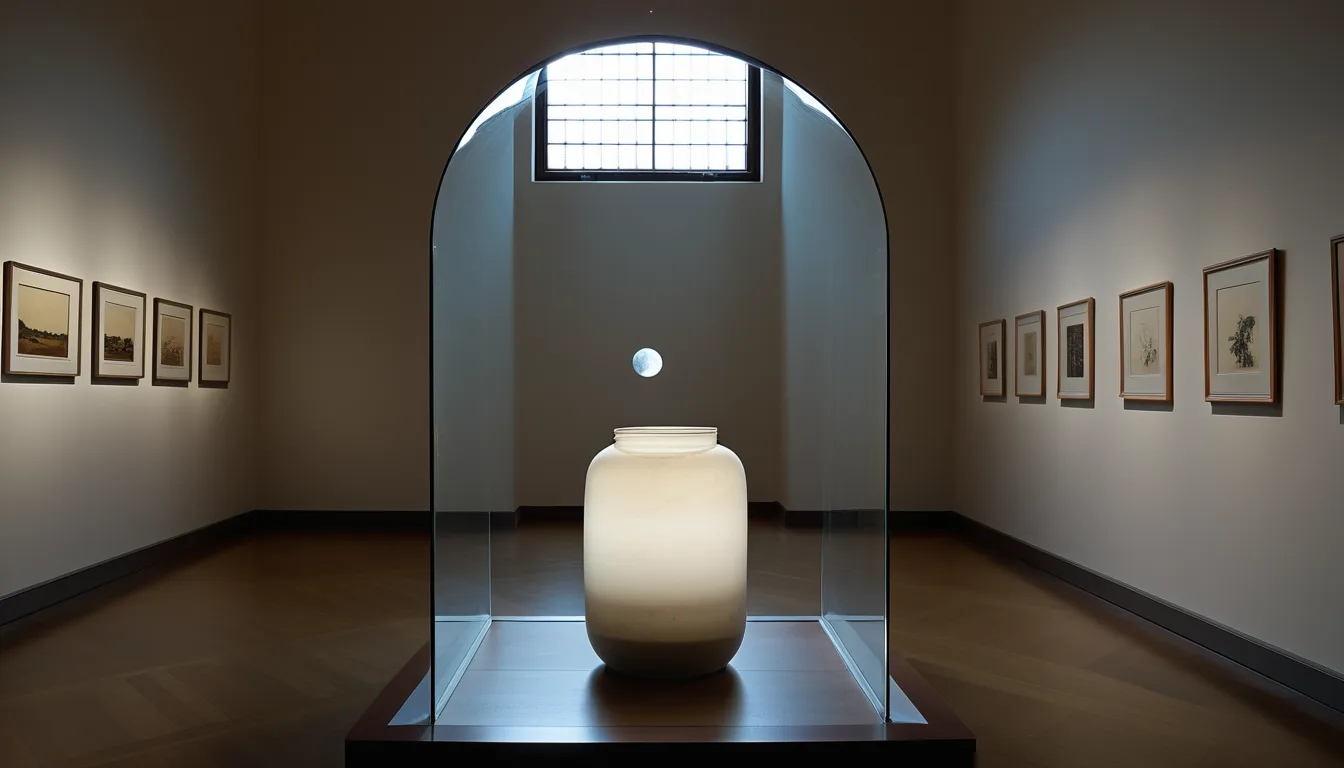
The Samsung Museum of Art Leeum in Yongsan-gu, Seoul, holds the National Treasure white porcelain moon jar described by the Korea Heritage Service. The description gives its dimensions: "The National Treasure white porcelain moon jar measures 44 cm in height and 42 cm in body diameter, with a short mouth rim sloping at about 45°."
This points in a different direction from the "irregular roundness" described earlier. The key point in the description of this National Treasure is that the joined section is barely distorted. Because asymmetry is the common tendency, the near-circular profile was arguably singled out for mention. The figures of 44 cm in height and 42 cm in body diameter put its round proportions into numbers.
The Korea Heritage Service also describes a National Treasure white porcelain jar in Haeundae-gu, Busan. It measures 49.0 cm in height, 20.1 cm across the mouth and 15.7 cm across the base. The Encyclopedia of Korean Culture's "Moon Jar" entry mentions the National Museum of Korea's white porcelain moon jar, Treasure No. 1437. Objects of the same type, then, can be designated at different levels: some as National Treasures, others as Treasures. The sources also record different measurements. They give the body diameter for the Leeum jar and the mouth and base diameters for the Busan jar.
Auction records in Wikipedia's "Moon jar" article and jars in Korea and abroad
As noted above, the "White Porcelain Moon Jar" entry says a considerable number of moon jars survive in Korea and abroad. Wikipedia's "Moon jar" article reports auction records. Several moon jars have sold for more than $1 million. In March 2023 one sold for $4.5 million. At an auction in March 2025, another fetched $2.8 million.
The two records show that prices have not moved in only one direction. The 2025 price was lower than the 2023 record. The difference in figures alone is therefore not enough to judge where the market is heading.
Set the auction records beside the dating evidence and a contrast emerges. The market values moon jars highly. Yet the Korean sources say not a single piece exists that could serve as a benchmark for dating. Price and date of production, in other words, answer different questions. When a moon jar turns up in an auction report, keep the two kinds of information apart.
Between a full moon and a waning moon: how the name came about
The Encyclopedia of Korean Culture's two entries give slightly different grounds for the name. The "White Porcelain Moon Jar" entry says: "It is called a moon jar because the round curve and full form of its body resemble a round moon." The "Moon Jar" entry says: "The moon jar is so named because its snow-white body color and round form resemble a full moon." The first entry cites only the shape. The second adds the white color.
Wikipedia's "Moon jar" article says when the name appeared: the nickname "moon jar" was only given in the 1950s. The same article says moon jars first appeared in the late 17th century. A long gap separates the first jars from their naming. "Moon jar," then, is a later name.
Wikipedia also uses a different image for the shape. Because of their slightly uneven form, it says, most moon jars resemble a waning moon rather than a full moon. The Korean sources speak of a full moon; Wikipedia speaks of a waning one. The difference suggests the name reflects the viewer's impression more than a precise description of the shape.
Joseon moon jars beside Chinese and Japanese white porcelain jars
Wikipedia's "Moon jar" article briefly notes how Korea differs from its neighbors. Vessels of this form, it says, are unique to Joseon and were never made in China or Japan. Among the sources used here, this is the only passage that addresses China and Japan.
Side by side, the differences are as follows. First, whether such jars were made at all: Wikipedia says Joseon made this form, but China and Japan did not. Second, when they appeared: the same article says Joseon moon jars first appeared in the late 17th century. Third, technique: the Korean sources explain that potters made large Joseon porcelain vessels by joining an upper and a lower half.
This comparison concerns jars of "this form," not white porcelain as a whole. It gives no grounds for belittling Chinese or Japanese white porcelain jars in general. The properties of Joseon white clay and the joining technique discussed earlier come from Korean sources. Taken together, they show that these sources describe the moon jar in terms of Joseon materials and techniques.
Moon jars since the 1950s: Kim Whanki and Bernard Leach
Wikipedia's "Moon jar" article also covers the period from the 20th century on. Moon jar production resumed in Korea in the 1950s. About 150 Korean potters have made moon jars since then. The article adds that moon jars inspired artists such as Kim Whanki and Bernard Leach.
The nickname discussed earlier and the revival of production both date to the 1950s. The article presents the two facts separately. Put together, they offer two ways to see today's moon jar. It is an artifact of late Joseon. It is also an object that was made again and named anew from the mid-20th century onward.
The distinction is useful in the gallery too. Read late Joseon artifacts within the estimated ranges of dates and kilns discussed above. Read moon jars by potters working since the 1950s as part of the revived tradition. Telling apart these two kinds of jar that share one name is a good first step toward seeing them accurately.
| Source | Subject | Passages used here | Difference from other sources |
|---|---|---|---|
| Encyclopedia of Korean Culture, "Moon Jar" | Moon jars in general and the National Museum of Korea's jar | Joining of upper and lower bodies, shapes varying with the maker's touch, Treasure No. 1437 | Attributes joining to large size and cites the white body color as a basis for the name |
| Encyclopedia of Korean Culture, "White Porcelain Moon Jar" | Large, milky-white porcelain jars at least 40 cm tall | Traces of the joint, refractoriness of Joseon white clay, absence of pieces for dating | Attributes joining to the properties of the white clay |
| Korea Heritage Service, description of the National Treasure white porcelain moon jar | National Treasure held by the Samsung Museum of Art Leeum | 44 cm tall, 42 cm body diameter, side profile tracing an almost perfect circle | Points to the first 50 years of the 18th century and the Geumsa-ri kiln |
| Korea Heritage Service, description of the National Treasure white porcelain jar in Haeundae-gu, Busan | National Treasure located in Haeundae-gu, Busan | 49.0 cm tall, upper and lower halves of a large jar joined | Gives mouth and base diameters instead of body diameter |
| Wikipedia, "Moon jar" | Moon jars in general | 1950s nickname, auction records, comparison with China and Japan | Describes a waning-moon shape and popularity lasting until the mid-18th century |
| Wikipedia, "Joseon white porcelain" | Joseon white porcelain in general | Founding of the branch kiln at Bunwon-ri, Gwangju, in 1751 | Its date does not match the main production period in the Korean sources |
Related reading: Gache: How Banning Korea's Traditional Hairpiece Changed Joseon Women's Hair · Bojagi and Jogakbo: What Korea's Traditional Wrapping Cloths Have Wrapped and Joined
Conclusion
The sources explain the moon jar's shape as the product of several overlapping conditions. They point in turn to large size, white clay that does not stand up well to fire, the joining of upper and lower halves, and the maker's own touch. Yet near-circular jars such as the National Treasure at the Leeum are also on record. And the name itself is a nickname from the 1950s.
Some questions remain open. With no benchmark pieces for dating, the period of production remains an estimate. It is also unclear how to reconcile the 1751 founding of the branch kiln with a production period centered on the early 18th century. The original texts are available in the "Moon Jar" and "White Porcelain Moon Jar" entries on the Encyclopedia of Korean Culture website. The National Treasure descriptions are in the heritage information on the Korea Heritage Service website.