The Short Answer
In Yisaeng Gyujang-jeon (李生窺墻傳), Lady Choe dies and then returns for a short time with the Heavenly Emperor's permission. She leaves again because her name has been entered in the register of ghosts. Her return and parting can be read as a device that briefly reconnects a love severed by war. Lady Gi in Chwiyu Bubyeokjeong-gi (醉遊浮碧亭記) is a different kind of figure. She is a daughter of Gija who ascended to the heavenly realm and became an immortal maiden. This article is the second in a three-part series.
Both works appear in Geumo Sinhwa (金鰲新話), the story collection by Kim Si-seup (金時習). According to the Encyclopedia of Korean Culture, the original manuscript of Yisaeng Gyujang-jeon does not survive. The work is preserved, together with four others, in a woodblock edition of Geumo Sinhwa printed in Tokyo, Japan. This article reads the key scenes of both works in the original. It then compares them with Aiqing zhuan (愛卿傳), from volume 3 of the story collection Jiandeng Xinhua (剪燈新話), and with the tradition of siae (屍愛) tales, stories of love between the living and the dead.
Placed side by side, Yisaeng Gyujang-jeon and Aiqing zhuan share four elements: war, a woman's death, a judgment from heaven or the underworld, and a farewell. The encyclopedia, by contrast, sets Chwiyu Bubyeokjeong-gi apart as a work about spiritual love. So although the two Geumo Sinhwa works sit in the same collection, there is a case for reading them separately.
Yisaeng Gyujang-jeon: Poems over the Wall and a Peach-Blossom Branch
The original text is available on the Korean Wikisource page '번역:금오신화' and the Chinese Wikisource page '金鰲新話'. For how the work became known again, see how Geumo Sinhwa was rediscovered. According to the encyclopedia, Yi Saeng (李生), the hero, lives in Songdo and meets Lady Choe, the daughter of a yangban family, while attending school. Night after night he climbs over the wall of her house to meet her in secret. The encyclopedia attributes the obstacles to their marriage to the difference in social status, or lineage, between the two families.
The original describes what happens after Yi Saeng hears Lady Choe's poem: "生聞之, 不勝技癢, 然其門戶高峻, 庭闈深邃, 但怏怏而去. 還時以白紙一幅, 作詩三首, 繫瓦礫投之曰" In other words, Yi Saeng could not resist the urge to show off his own skill. But the gate was high and the inner courtyard deep, so he left disappointed. He then wrote three poems on a sheet of white paper, tied it to a piece of roof tile and threw it over the wall.
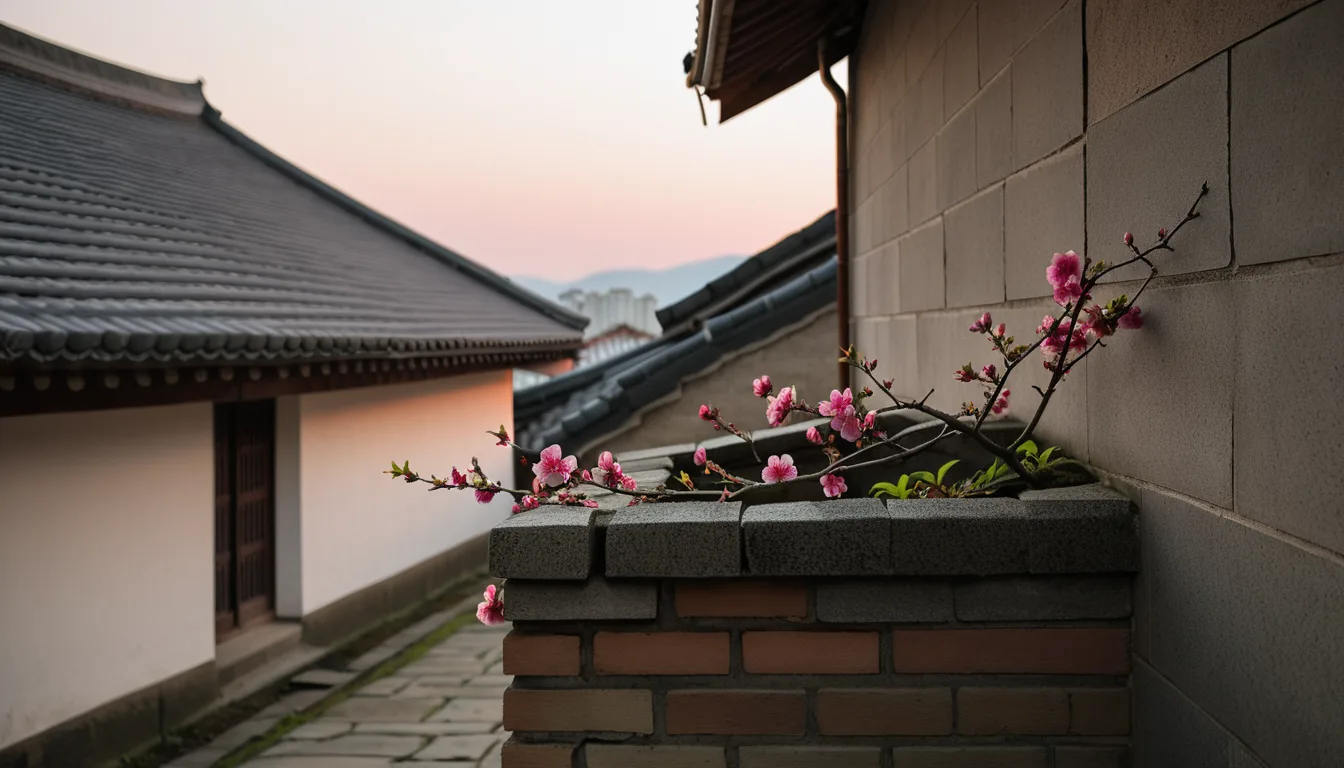
In this passage the wall is both the boundary that separates the two and the channel through which poetry crosses. The high gate and deep courtyard can be read as giving spatial form to the family difference the encyclopedia mentions. The scene on the appointed day also takes place at the wall: "生如其言, 乘昏而往, 忽見桃花一枝, 過墻而有搖裊之影." That is, Yi Saeng went at dusk as she had told him, and a single peach-blossom branch was swaying over the wall. The branch can be read as an answer sent from the other side.
The wall is not the only thing that separates them. In the original, Yi Saeng's father gives an order: "速去嶺南, 率奴隷監農, 勿得復還.” 卽於翌日, 謫送蔚州." He tells his son to go at once to Yeongnam, oversee the farming with the servants and never come back. The next day he sends him down to Ulju. If the wall was a boundary that could be crossed, here it is distance that arguably keeps the two apart.

Yisaeng Gyujang-jeon: The Red Turban Invasion of the Sinchuk Year and Lady Choe's Death
The encyclopedia's summary says that both families were killed in the Red Turban invasion and only Yi Saeng survived. The original describes the upheaval this way: "辛丑年,紅賊據京城,王移福州. 賊焚蕩室廬,臠炙人畜." In the sinchuk year, the Red Turbans seized the capital and the king moved to Bokju. The bandits burned houses and harmed people and livestock.
The passage is short, but it places the couple's love in the middle of a national catastrophe. In the previous section, the obstacles came from the family and the father. Here the obstacle is a war that wipes out both households. The nature of the obstacle can be read as shifting from family opposition to the violence of the world.
The original describes Lady Choe's capture by the bandits: "女爲賊所虜,欲逼之,女大罵曰: “虎鬼殺啗我,寧死葬於豺狼之腹中,安能作狗彘之匹乎?” 賊怒,殺而剮之." When the bandits tried to force themselves on her, she berated them loudly. Let a tiger-like demon kill and devour her, she cried; she would rather be buried in the bellies of jackals and wolves. How could she ever become the mate of dogs and swine? Enraged, the bandits killed her.
Lady Choe is not portrayed simply as a victim here. She refuses in words, and she dies for it. To understand her return, it arguably helps to look first at how she died. The Heavenly Emperor's judgment that she bore no sinful karma comes up again later, in the parting scene.
Yisaeng Gyujang-jeon: Yi Saeng's Reunion with the Dead Lady Choe
After Lady Choe's death, Yi Saeng is left alone. Then footsteps sound beneath the corridor, faint at first and gradually drawing nearer. It is Lady Choe. Yi Saeng knows she is already dead, but his love is so deep that he has no further doubts.
The key phrase here is 不復疑訝: he doubted no more. Yi Saeng is not unaware of her death. He knows she is dead and still accepts her. The scene can be read as declining to portray the returning dead as something to fear.
The returned Lady Choe recalls how their love began: "一窺紅杏之墻,自獻碧海之珠. 花前一笑,恩結平生" In other words, after a single glimpse over the wall of red apricot blossoms, she offered up the pearl of the blue sea of her own accord. With one smile before the flowers, they formed a lifelong bond. Her words contain two characters from the work's title: 窺 (to peer) and 墻 (wall). The dead Lady Choe can be read as taking the story back to its opening scene at the wall.
In the original, the couple find the place where their valuables had been buried and recover gold, silver and other goods. They also gather the remains of both sets of parents. Their days are described this way: "雖親戚賓客賀弔, 杜門不出, 常與崔氏, 或酬或和, 琴瑟偕和, 荏苒數年." Even for the celebrations and funerals of relatives and guests, Yi Saeng kept his gate shut and did not go out. He exchanged poems with Lady Choe and lived in happy harmony with her for several years. A relationship that began with poems thrown over a wall can be read as having become one of poems exchanged behind closed doors.
Yisaeng Gyujang-jeon: The Illusory Body Lent by Heaven and the Final Parting
The reunion has a fixed end. Lady Choe explains why she has come back: "天帝以妾與生,緣分未斷,又無罪障,假以幻體,與生暫割愁腸,非久留人世,以惑陽人." The Heavenly Emperor judged that the couple's bond had not been severed and that she bore no sinful karma. So he lent her an illusory body to let them ease their sorrow for a while. It was not meant for her to linger in the human world and lead the living astray.
She goes on: "李郞之壽, 剩有餘紀, 妾已載鬼籙, 不能久視." Master Yi still has many years to live, she says, but she is already entered in the register of ghosts and cannot stay long. These two passages place her return within an order of heavenly judgment and registers of the dead. Her return can be read as a meeting with a set time limit.
The ending is brief: "生拾骨,附葬于親墓傍. 旣葬,生亦以追念之故,得病數月而卒." Yi Saeng gathered Lady Choe's bones and buried them beside his parents' graves. After the burial, he too fell ill from longing and died a few months later. The encyclopedia's summary agrees: Yi Saeng longed for her day after day, fell ill and died.
Lady Choe's death came from a bandit's blade; Yi Saeng's comes from longing. This contrast can be read as a pattern in which the force that blocks love and the heart that keeps it stay opposed to the end. Note, too, that Lady Choe's own bones are buried beside the parents' remains she gathered after her return.
Chwiyu Bubyeokjeong-gi: Hong Saeng Meets Lady Gi at Bubyeokjeong
Chwiyu Bubyeokjeong-gi is another work in Geumo Sinhwa. The original introduces its hero: "天順初,松京有富室洪生,年少美姿容,有風度,又善屬文." Early in the Tianshun (天順) era, a man named Hong Saeng (洪生) lived in Songgyeong. He came from a wealthy family, was young and handsome, had a refined bearing and wrote well.
According to the encyclopedia's summary, Hong Saeng, a merchant from Gaeseong, climbs Bubyeongnu Pavilion on the Daedong River one moonlit night while drunk. There he composes and recites poems lamenting the rise and fall of the old kingdom. A maiden then appears and introduces herself: "娥噫而答曰: “弱質,殷王之裔,箕氏之女. 我先祖,實封于此" With a sigh, she answers that she is a descendant of the kings of Yin and a daughter of the Gi clan. Her ancestor, she adds, was in fact enfeoffed in this very place.
The encyclopedia explains that she is the daughter of Gija, who lost his kingdom to Wiman. She ascended to the heavenly realm and became an immortal maiden. What defines Lady Gi, then, is not death but her lineage and how she became an immortal. The encyclopedia likens the work to Manboksa jeopo-gi and Yisaeng Gyujang-jeon, since all three deal with love between a man and a woman. Yet it distinguishes the work from both as a story of spiritual love. Hong Saeng's lament for the old kingdom and Lady Gi's account of her lineage can be read as interlocking.
According to the encyclopedia, Hong Saeng died after dreaming that he would ascend to heaven through Lady Gi's arrangement. The original reads: "奄然而逝,卽九月望日也. 殯之數日,顔色不變,人以爲遇仙屍解云." Hong Saeng died on the fifteenth day of the ninth month. Several days after he was laid in state, his complexion had not changed. People believed he had met an immortal and shed his mortal body. In Yisaeng Gyujang-jeon, a dead woman comes down to the world of the living. Chwiyu Bubyeokjeong-gi can be read as a living man rising to heaven, so the two works appear to move in opposite directions.
Aiqing zhuan from Jiandeng Xinhua and Yisaeng Gyujang-jeon: A Point-by-Point Comparison
The heroine of Aiqing zhuan, in volume 3 of Jiandeng Xinhua, is Luo Aiai (羅愛愛). The original introduces her this way: "羅愛愛,嘉興名娼也,色貌才藝,獨步一時。" She was a famous courtesan of Jiaxing whose beauty and talents were unrivaled in her day. The story is set in wartime. In the 16th year of Zhizheng (至正), Zhang Shicheng (張士誠) captured Pingjiang. In the 17th year, the Miao army under Yang Wanzhe (楊完者) held the line at Jiaxing.
In the original, Myriarch Liu wants to take Aiqing for himself, and she deceives him with sweet words: "愛卿以甘言給之,沐浴入閤,以羅巾自縊而死。" She then bathed, went into her room and hanged herself with a silk kerchief. Later, Master Zhao (趙子) returned and dug beneath the ginkgo tree. Her face and skin were just as they had been in life. Aiqing tells him: "妾之死也,冥司以妾貞烈,即令往無錫宋家。托為男子。妾以與君情緣之重,必欲俟君一見,以敘懷抱,故遲之歲月耳。" The underworld court had recognized her chastity and ordered her to be reborn as a boy in the Song family of Wuxi. She had put this off so that she could see Zhao once more.
The farewell comes at cockcrow: "雞鳴而起,下階斂步,復回顧拭淚云:「趙郎珍重,從此永別矣!」" When the cock crowed, Aiqing rose and stepped down from the stone stairs. Then she turned back once more, wiped away her tears and said, "Take care, my dear Zhao. From now on we are parted forever." Like Lady Choe's, this farewell can be read as a parting that cannot be put off.
Set side by side, the two works line up as follows. The war: in Yisaeng Gyujang-jeon, the Red Turbans' seizure of the capital; in Aiqing zhuan, Zhang Shicheng's capture of Pingjiang. The woman's death: a bandit's blade for Lady Choe, a silk kerchief for Aiqing. The judgment after death: the Heavenly Emperor's illusory body for Lady Choe, the underworld court's order of rebirth for Aiqing. The words of parting: the register of ghosts for Lady Choe, a farewell forever after cockcrow for Aiqing. These parallels do not prove influence. They are better treated as shared elements worth reading side by side.
Ghost-Marriage Fiction and Siae Tales: Where Yisaeng Gyujang-jeon and Chwiyu Bubyeokjeong-gi Fit
The encyclopedia describes siae tales as stories of love and contact between the living and the dead. They are also known as myeonghon (冥婚, ghost-marriage) tales. The encyclopedia notes that, because Yisaeng Gyujang-jeon deals with love between the living and the dead, it is also called a myeonghon novel. Chwiyu Bubyeokjeong-gi, too, is called a myeonghon or siae novel because of its structural type. Yet, as noted above, it is also set apart as a story of spiritual love. If the same label was applied on the basis of structure, the differences in content arguably need to be read separately.
Manboksa jeopo-gi (萬福寺樗蒲記), also in Geumo Sinhwa, likewise features a woman who died in a time of upheaval: "吾止有一女子, 當寇賊傷亂之時, 死於干戈, 不能窀窆, 殯于開寧寺之間" The speaker had only one daughter, who died by the sword when bandits brought chaos. She could not even be given a burial; her body was simply laid in state near Gaenyeongsa Temple. The upheaval is interpreted as the raids of Japanese pirates. War and a woman's death can thus be seen recurring within the same collection.
The encyclopedia explains that the corpse itself rarely features in siae tales. Most are stories of intimacy with the spirit of the dead. By that measure, the scene beneath the ginkgo tree in Aiqing zhuan stands out. There Master Zhao sees with his own eyes a body that looks just as it did in life. In Yisaeng Gyujang-jeon, by contrast, Yi Saeng gathers bones, and the Lady Choe who appears before him is an illusory body. The two works can be read as diverging in how they show the dead body.
The encyclopedia cites Manboksa jeopo-gi and Yisaeng Gyujang-jeon as examples of myeonghon tales expanded into fiction. They are credited with literary achievement through solid narratives and the Chinese poems woven into them. In these jeongi tales, it adds, the fear and revulsion of the folk tales disappear. The stories become romances that transcend death. The author of the encyclopedia's Yisaeng Gyujang-jeon entry does not read the dead woman literally. The entry treats her as a paradox: a device that exposes the clash between the will to love and a world that will not allow it. The wall, the father's order and the Red Turbans' blades discussed earlier can all be read as faces of that 'world'.
| Work | Collection | Who the woman is | Passages used in this article |
|---|---|---|---|
| Yisaeng Gyujang-jeon | Geumo Sinhwa | Lady Choe, a yangban daughter whom Yi Saeng of Songdo meets over the wall | Poems thrown over the wall; the Red Turban invasion; parting from Lady Choe after her return in an illusory body |
| Chwiyu Bubyeokjeong-gi | Geumo Sinhwa | Lady Gi, daughter of Gija (who lost his kingdom to Wiman), who became an immortal maiden | Hong Saeng's introduction; Lady Gi's self-introduction; Hong Saeng's death on the fifteenth day of the ninth month |
| Manboksa jeopo-gi | Geumo Sinhwa | A woman who died during the Japanese pirate raids and was laid in state near Gaenyeongsa Temple | The passage about the daughter who could not be buried |
| Aiqing zhuan | Jiandeng Xinhua, vol. 3 | Luo Aiai, a famous courtesan of Jiaxing | Her suicide after deceiving Myriarch Liu; the underworld court's judgment; the farewell after cockcrow |
Related reading: Kim Si-seup's Geumo sinhwa (New Tales of Mount Geumo): How It Was Written and Rediscovered (1/3)

Summary
The discussion above suggests that, in Yisaeng Gyujang-jeon, poetry restores love each time it meets an obstacle. First come the three poems thrown over the wall. Later come the poems exchanged for several years with the returned Lady Choe. Lady Choe's recollection takes the story back to the wall scene of the title. Chwiyu Bubyeokjeong-gi takes a different path. It moves through lineage and the rise and fall of the old kingdom to an ending in which the hero ascends to heaven.
Some questions remain. The encyclopedia notes a view that the events of Chwiyu Bubyeokjeong-gi are an allegory of Grand Prince Suyang's usurpation of King Danjong's throne. On that reading, Lady Gi's account of her lineage could take on a different meaning. Moreover, once myeonghon tales became an element of fiction from the 17th century onward, their poignant character was sometimes turned into comedy. How the serious myeonghon narratives of Geumo Sinhwa relate to that change deserves further study.