The short answer: Jongmyo is a state shrine where royal ancestral tablets are kept and honored with rites
Jongmyo is the state shrine that holds the spirit tablets of the royal ancestors of Joseon and the Korean Empire. The Royal Palaces and Tombs Center of the Korea Heritage Service describes it as the place where the tablets of kings and queens, emperors and empresses are enshrined and honored with rites. A palace's main hall was where the king held court. Jongmyo, by contrast, can be seen as the place where the ancestors' tablets reside. This is the seventh and final part of a seven-part series.
The earlier installments looked at the palaces one by one. This final one turns to the space the same royal house built for its ancestors. More than buildings survive at Jongmyo. The ancestral rite, Jongmyo Jerye, and its music, Jongmyo Jeryeak, continue to this day. UNESCO added Jongmyo to the World Heritage List in 1995. In 2001 it proclaimed the rite and its music as intangible heritage of humanity.
The founding: the Annals entry for the ninth month of 1395
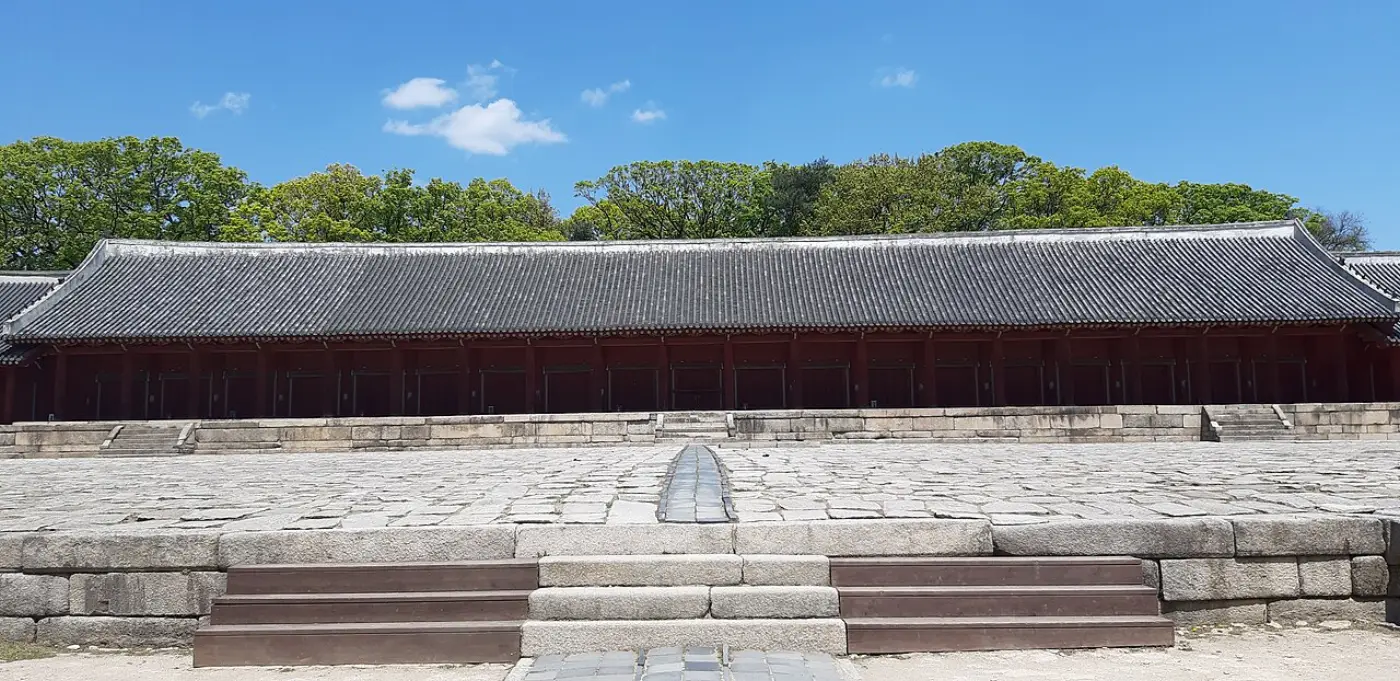
Jongmyo was built on its present site in 1395 (the fourth year of King Taejo), after the founding of Joseon. According to the Royal Palaces and Tombs Center, the site followed an established principle: “with the palace as the reference point, the royal ancestral shrine stands on the left and the altar to the gods of earth and grain (Sajik) on the right.” At its founding, Jongmyo had a seven-bay main hall. It held the spirit tablets of Taejo's four ancestral generations: Mokjo, Ikjo, Dojo and Hwanjo.
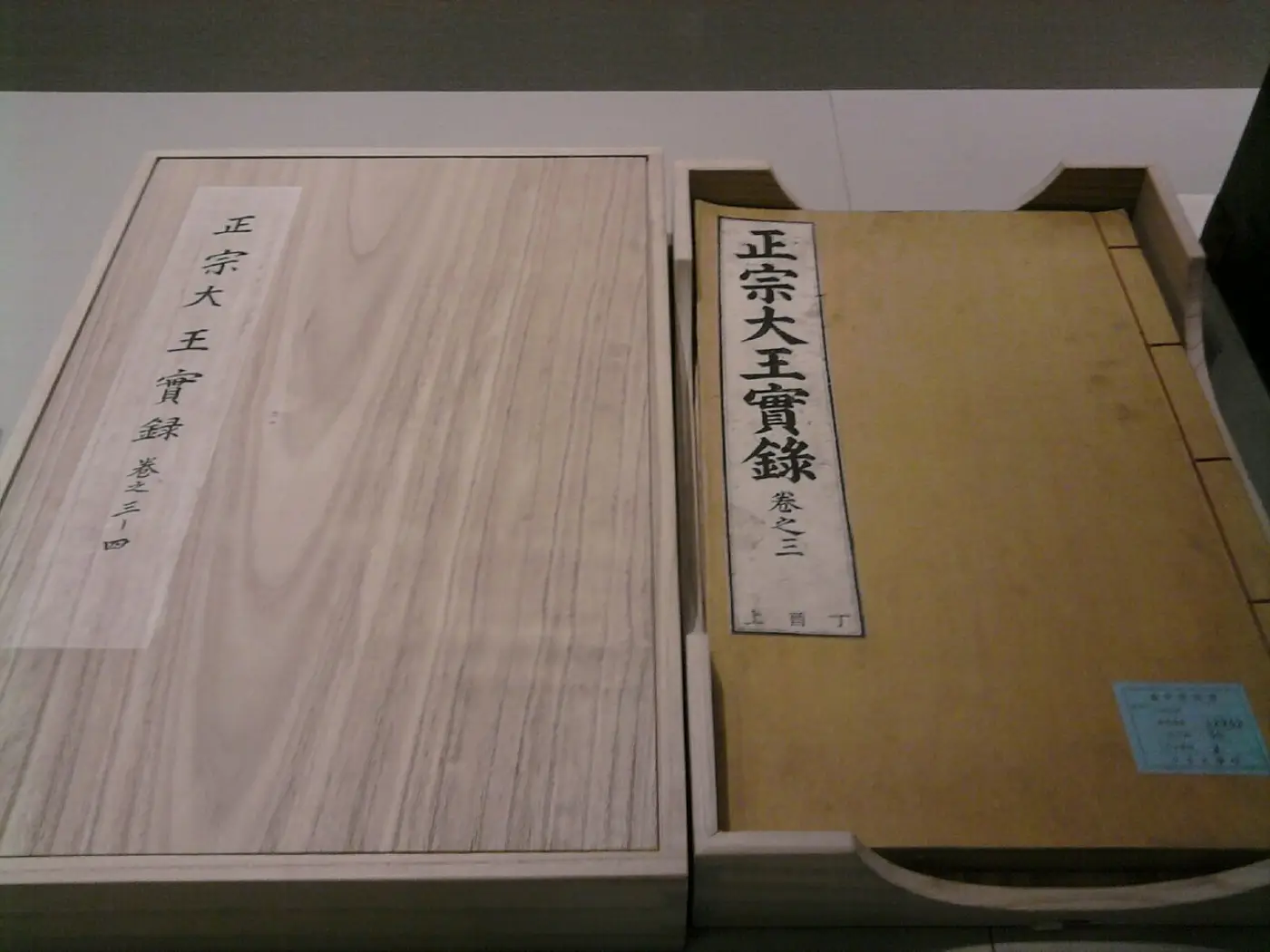
The Annals of the Joseon Dynasty, published by the National Institute of Korean History, also document the founding. The entry for the ninth month of 1395 reads: “This month, the Great Shrine (大廟) and the new palace were completed.” Here the Great Shrine means Jongmyo. It comprised a five-bay stone chamber and left and right wings of two bays each. It also had a five-bay Hall of Meritorious Subjects (功臣堂), a three-bay spirit gate (神門), a three-bay east gate and a one-bay west gate.
The same entry describes the new palace's main hall as five bays, used for receiving the court. A single entry thus sets the space for the ancestors beside the space for the court. Jongmyo and the palace are best read together as state institutions. The Royal Palaces and Tombs Center's “seven-bay main hall” also matches the Annals' “great chamber of seven bays.” Readers can find the entry on the National Institute of Korean History's Annals of the Joseon Dynasty website.
Yeongnyeongjeon: the 1421 annex, the 1836 expansion, and the 19 and 16 chambers
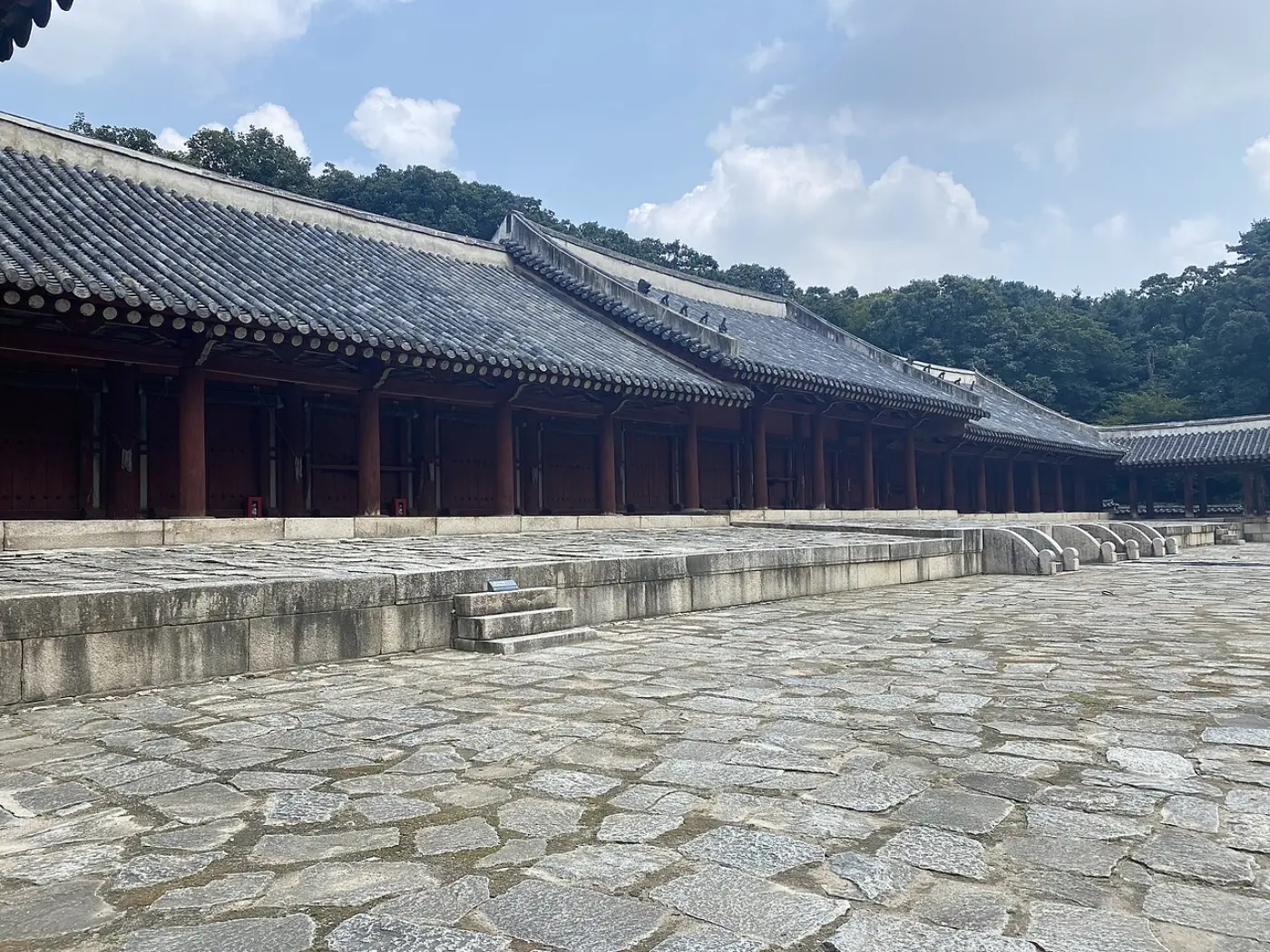
In 1421 (the third year of King Sejong), King Jeongjong's spirit tablet was due to be enshrined at Jongmyo, but there were not enough chambers. So an annex shrine was built, and the tablets of Taejo's four ancestral generations were moved there. The Encyclopedia of Korean Culture, published by the Academy of Korean Studies, names this annex Yeongnyeongjeon. In 1836 (the second year of King Heonjong), the main hall and Yeongnyeongjeon were each extended by four bays. The main hall reached 19 bays and Yeongnyeongjeon 16.
According to the Encyclopedia of Korean Culture, the main hall's 19 chambers hold the spirit tablets of 19 kings and 30 queens. The Seoul Shinmun newspaper describes them as 49 tablets of Joseon kings and queens and Korean Empire emperors and empresses. Yeongnyeongjeon's 16 chambers hold the tablets of 15 kings and 17 queens moved out of the main hall, a process called jocheon. The tablet of Imperial Crown Prince Uimin (懿愍皇太子) is also kept there. In other words, the two buildings are not separate shrines. They form a single system through which tablets move.
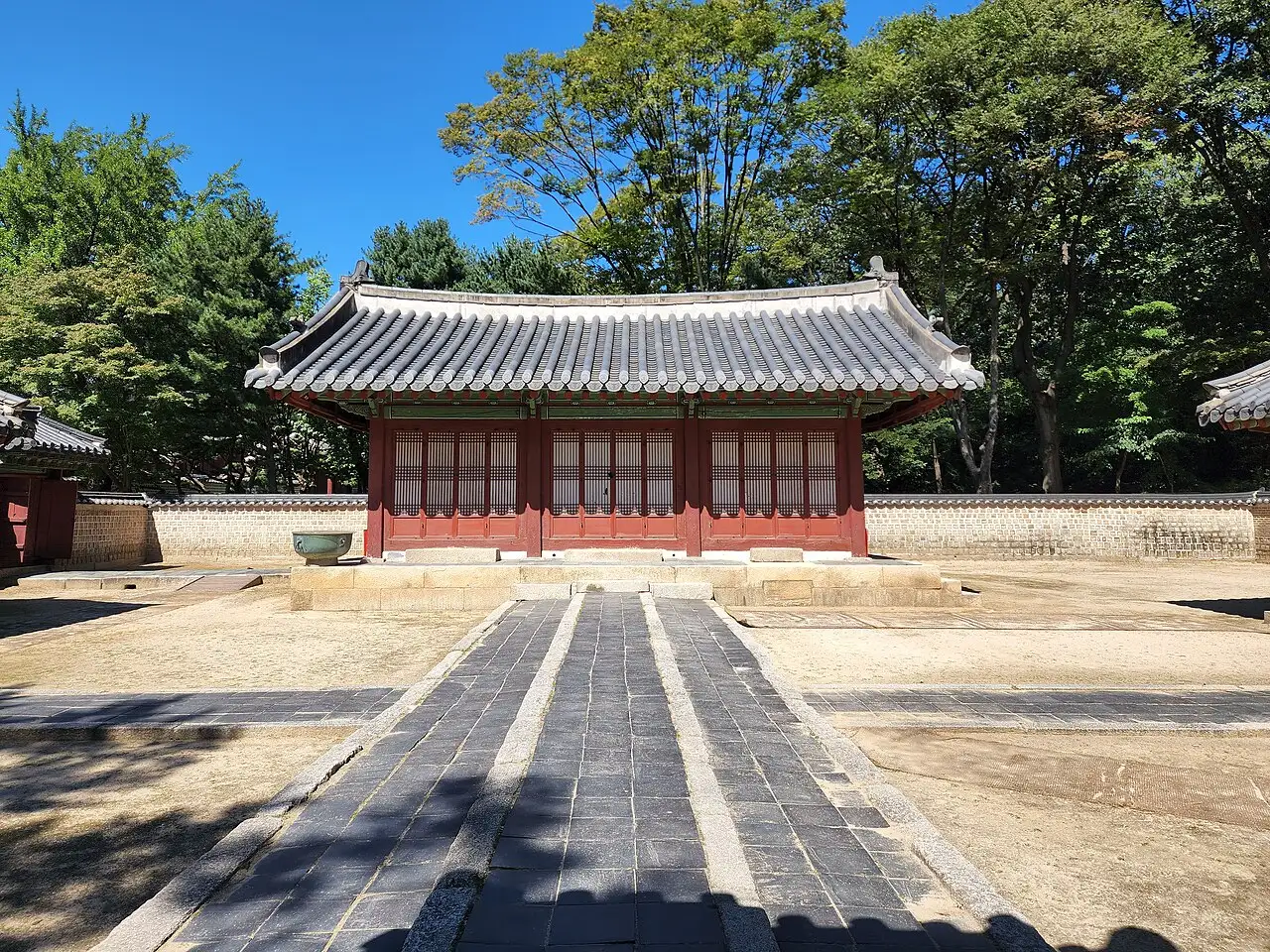
The two buildings also look different. In the main hall, the walls hide every column except the front row along the porch bay. Yeongnyeongjeon exposes its round columns, which divide the walls. Yeongnyeongjeon is painted in just two colors, red and blue-green. This contrasts sharply with the lavishly multicolored palaces. Ornamental ridge-end pieces (chwidu, 鷲頭) and rows of small figures (japsang, 雜像) sit along the roof ridges. For more on the figures, see japsang: the small figures on palace roof ridges.
After the Imjin War: rebuilt in 1608 and reopened with the 2025 Hwananje
Today's Jongmyo buildings are not those of the 1395 founding. Jongmyo burned during the Imjin War. According to the Encyclopedia of Korean Culture, reconstruction was discussed from 1604 (the 37th year of King Seonjo). Work on preparing the site and raising the columns began in Seonjo's 41st year. Jongmyo was rebuilt in May 1608, the year Gwanghaegun took the throne.
In the 21st century, the main hall underwent major repairs. Seoul Shinmun reports that signs of aging, such as damaged roof tiles and timbers, were identified in 2014. Repair and maintenance work began in 2020. The Encyclopedia of Korean Culture notes that all 70,000 roof tiles were newly made and replaced. Tree-ring dating during the work showed timber from Gwanghaegun's reign in the 17th century. The repairs also uncovered a ridge-beam inscription written when King Yeongjo extended the main hall in 1726. Both the 1608 reconstruction record and the age of the wood point to Gwanghaegun's reign, which can be read as a case of documents and physical evidence confirming each other.
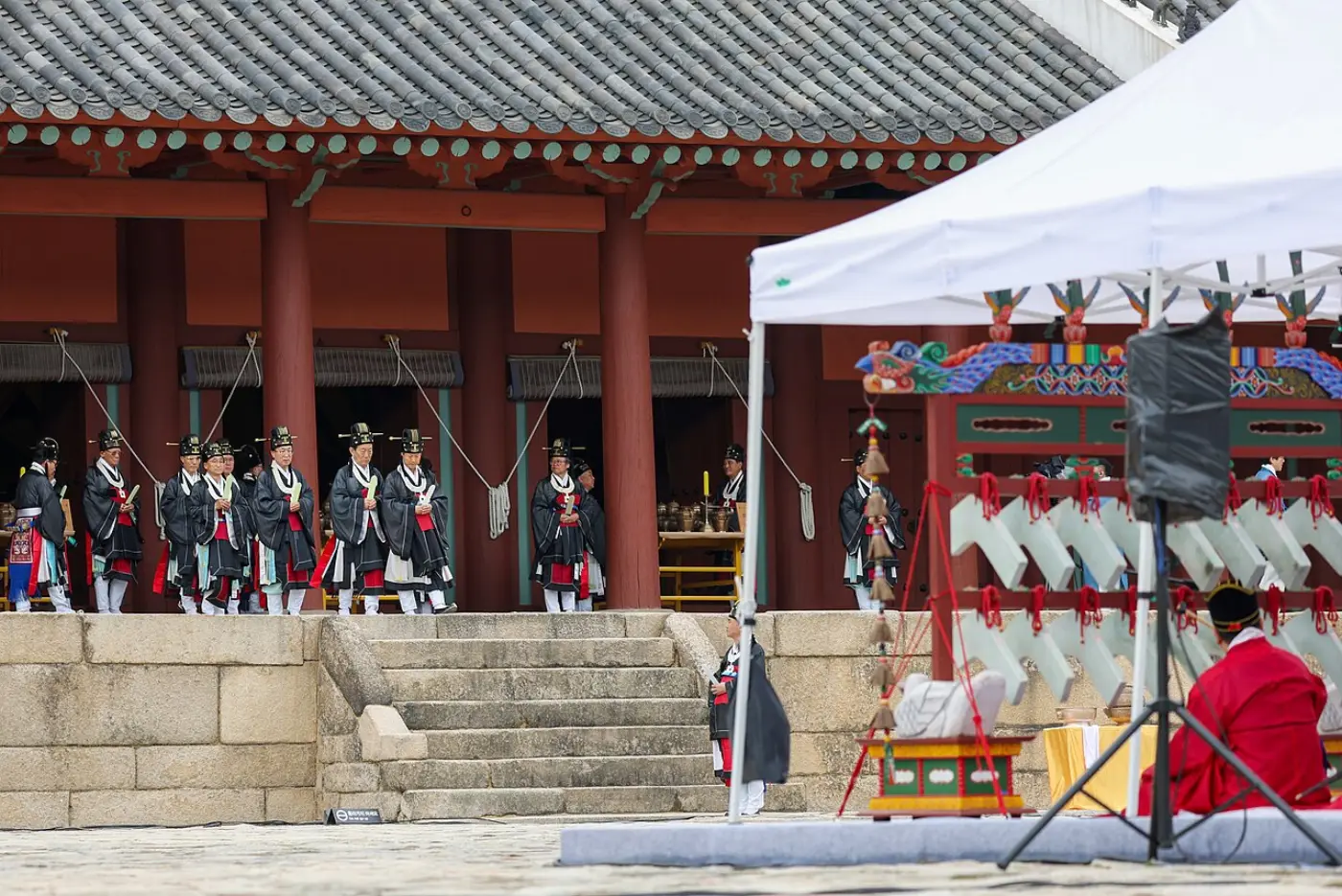
The main hall reopened to the public on April 20, 2025. That day also saw the Hwananje, a ceremony that returns the spirit tablets to the main hall. According to Seoul Shinmun, it was the first such ceremony in 155 years, since 1870 (the seventh year of King Gojong). It was re-created from the Jongmyo Yeongnyeongjeon Jeungsu Dogam Uigwe, a record compiled under King Heonjong. In other words, a record from Heonjong's reign became the basis for reviving the ceremony today.
The ritual music: composed in 1447, proclaimed by UNESCO in 2001, and unlike China and Vietnam
Jongmyo Jeryeak is the dance, song and instrumental music performed during the rites at Jongmyo. The Korea Heritage Service notes that it is also called Jongmyoak. According to the agency, it was first composed in 1447 (the 29th year of King Sejong) for court banquets. It was then adapted for the rites in 1464 (the 10th year of King Sejo). Material from the Royal Palaces and Tombs Center, however, dates its official use to 1463 (the ninth year of Sejo). Because the two sources differ by a year, it is arguably safer to name the institution when citing either date.
The songs, called akjang, comprise 11 pieces of Botaepyeong and 11 of Jeongdaeeop. Two dances accompany the music. Botaepyeongjimu praises the civil virtues of the former kings, and Jeongdaeeopjimu extols their military achievements. UNESCO describes the dance as performed by 64 dancers in eight rows. It also says the rite is held once a year, on the first Sunday of May, presided over by descendants of the royal family. The Royal Palaces and Tombs Center, however, says the rites are currently held on the first Sunday of May and the first Saturday of November. This discrepancy shows why visitors should check the operating institution's announcements first when planning a visit.
Set beside China and Vietnam, Jongmyo differs on several points. In facade width, the Chinese ancestral temple has 9 bays, while Jongmyo's main hall has 19 (Encyclopedia of Korean Culture). On continuity, UNESCO presents Jongmyo Jerye as a unique example of a Confucian ritual no longer performed in China. It explains that the order of ceremony was set in the 15th century and has remained largely unchanged. On the scope of preservation, the Encyclopedia of Korean Culture notes that Korea's Jongmyo, unlike in China or Vietnam, preserves the rites and ritual music along with the buildings. UNESCO first proclaimed the rite and its music in 2001. It inscribed them on the Representative List of the Intangible Cultural Heritage of Humanity in 2008. Jongmyo's distinction, then, lies less in the size of its buildings than in the survival of buildings and ritual together.
| Year | Event | Source |
|---|---|---|
| 1395 (4th year of Taejo) | Jongmyo founded to the left of the palace; tablets of Taejo's four ancestral generations enshrined in a seven-bay main hall | Korea Heritage Service Royal Palaces and Tombs Center; National Institute of Korean History, Annals of the Joseon Dynasty |
| 1421 (3rd year of Sejong) | Annex shrine Yeongnyeongjeon built because there were not enough chambers to enshrine King Jeongjong's tablet | Academy of Korean Studies |
| May 1608 | Jongmyo rebuilt after burning in the Imjin War | Academy of Korean Studies |
| 1836 (2nd year of Heonjong) | Main hall and Yeongnyeongjeon each extended by four bays, to 19 and 16 bays respectively | Korea Heritage Service Royal Palaces and Tombs Center |
| 1995 | Jongmyo inscribed on the UNESCO World Heritage List | Korea Heritage Service Royal Palaces and Tombs Center; Seoul Shinmun |
| May 2001 | Jongmyo Jerye and Jongmyo Jeryeak proclaimed intangible heritage of humanity by UNESCO (inscribed on the Representative List in 2008) | Korea Heritage Service Royal Palaces and Tombs Center; UNESCO |
In sum: what to see at Jongmyo today, from the Jaesil to Yeongnyeongjeon
Jongmyo has endured alongside its records. The Annals recorded the scale of the founding. The uigwe compiled under Heonjong provided the basis for the 2025 Hwananje. Tree-ring dating pointed to the same period as the reconstruction record. A few questions remain open. Sources differ slightly on the year the ritual music came into official use and on the dates of the rites.
On site, you can walk the grounds by following the layout of the buildings. According to the Encyclopedia of Korean Culture, the main hall lies west of the Jaesil, and Yeongnyeongjeon lies west of the main hall. The Akgongcheong (樂工廳) lies southwest of the main hall. The Royal Palaces and Tombs Center's English-language materials also introduce Mangmyoru, Hyangdaecheong, Jaegung and Jeonsacheong. Jongmyo officials worked in Mangmyoru, and incense and written prayers were kept in Hyangdaecheong. The king and crown prince prepared for the rites in Jaegung, and the ritual food was prepared in Jeonsacheong. To close the series: the palaces were spaces for the living, and Jongmyo was a space for the ancestors.