A Field That Began with a Question
The history of artificial intelligence begins not with a machine but with a question. In October 1950, the British mathematician Alan Turing published a paper titled "Computing Machinery and Intelligence" in volume 59, issue 236 of the philosophy journal Mind. The paper opens by proposing the question "Can machines think?" Turing then sets the question aside almost at once. He saw that trying to define the words "think" and "machine" would not lead anywhere useful. Instead, he proposed what he called the imitation game: an interrogator exchanges written messages with an unseen partner and tries to tell whether that partner is a person or a machine. If a machine could pass as a person, Turing argued, there was no need to ask separately whether it was thinking.
I think the reason this paper is still read today lies not in its answer but in how it reshaped the question. By turning the inward problem of "does it think" into the outward test of "can it be told apart from a person," Turing made it possible to build machines and test them instead of arguing endlessly about intelligence. The feeling we have today when a conversational AI seems "human" was already written into a paper 75 years ago as a method of testing.
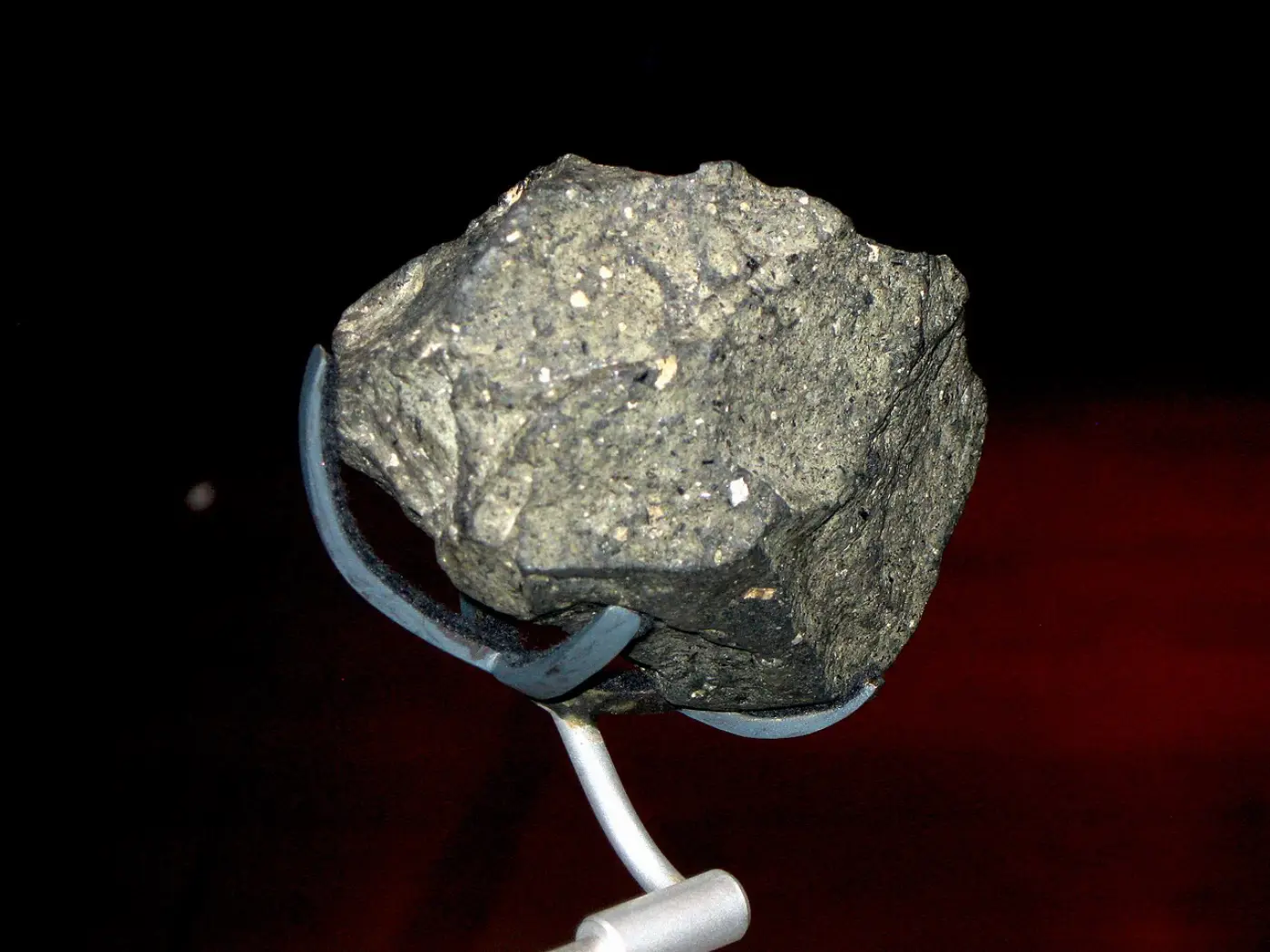
An Oldowan chopper from Olduvai Gorge in the British Museum, with the scars where flakes were struck off · Archaeomoonwalker · CC BY 3.0 · Wikimedia Commons
Summer 1955: The Field Gets Its Name
The term "artificial intelligence" first appears in a proposal dated August 31, 1955. It was written by four people: John McCarthy of Dartmouth College, Marvin Minsky of Harvard University, Nathaniel Rochester of IBM, and Claude Shannon of Bell Telephone Laboratories. The proposal called for a two-month, ten-person study of artificial intelligence at Dartmouth College in Hanover, New Hampshire, during the summer of 1956. It stated the conjecture on which the study would proceed in a single sentence: that every aspect of learning, or any other feature of intelligence, can in principle be described so precisely that a machine can be made to simulate it. The authors wrote that they would try to find out how to make machines use language, form abstractions and concepts, solve kinds of problems then reserved for humans, and improve themselves.
Reading that sentence again, two things stand out. One is ambition. Language, abstraction, problem-solving, and self-improvement remain the main branches of the field seventy years later. The other is modesty. The word the proposal used was "conjecture," and the time frame was a single summer. It was a suggestion that ten people spend two months finding out what might be possible. The name of the field was born in a gathering that small.
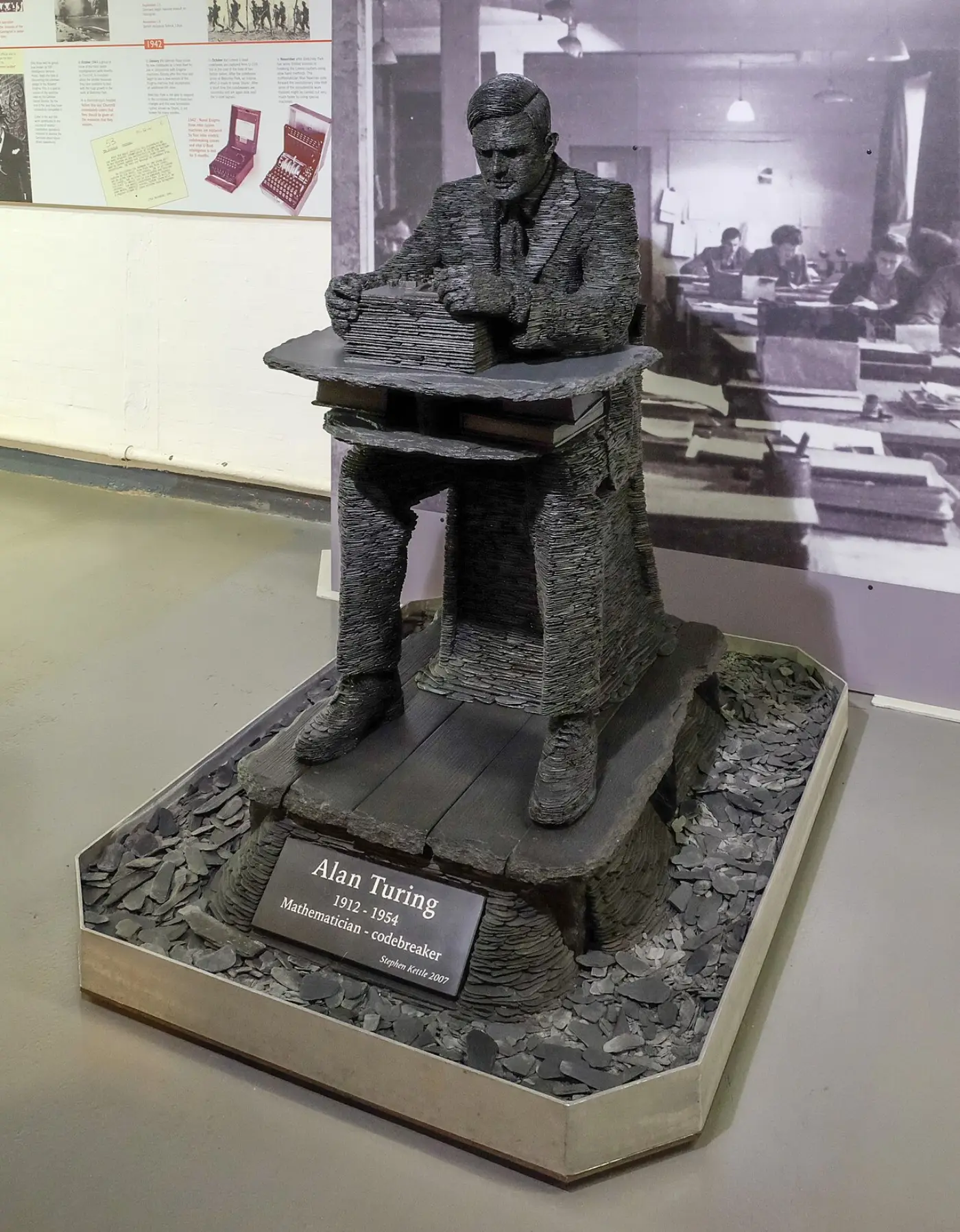
The slate sculpture of Alan Turing by Stephen Kettle (2007) in the Bletchley Park museum · DeFacto · CC BY-SA 4.0 · Wikimedia Commons
The First Program to Imitate Speech
In January 1966, Joseph Weizenbaum of MIT published the ELIZA paper in volume 9, issue 1 of Communications of the ACM. ELIZA ran on MIT's MAC time-sharing system. A person typed a sentence in ordinary language and the computer replied in ordinary language. The method was simple. The program looked for keywords in the input, broke the sentence apart with "decomposition rules," and built a reply with the "reassembly rules" attached to those decomposition rules. It did not understand what was said; it returned words according to rules.
The paper's own title describes ELIZA as a program for studying "natural language communication between man and machine." I think the lesson ELIZA left behind had more to do with human reactions than with the machine's ability. When words come back to us, we readily feel there is a mind behind them. That tendency works just as strongly today, sixty years later, when we use conversational AI. Separate from how clever a machine is, ELIZA showed first how easily we read a mind into it.
May 1997: The Day Calculation Beat Memory
More than forty years after the field got its name, in May 1997 in New York, IBM's chess computer Deep Blue defeated the reigning world champion Garry Kasparov by 3.5 games to 2.5. IBM records that Deep Blue could evaluate 200 million chess positions per second. While the human champion chose moves from memory and intuition, the machine calculated and compared an enormous number of possible moves.
Deep Blue was a machine that calculated, not one that learned. So I think it is more accurate to read this as a victory of computing power than a victory of intelligence. But what the event left behind is clear. In a game that people had long treated as a symbol of intellect, it was confirmed in public that a machine could surpass a person within a fixed set of rules.
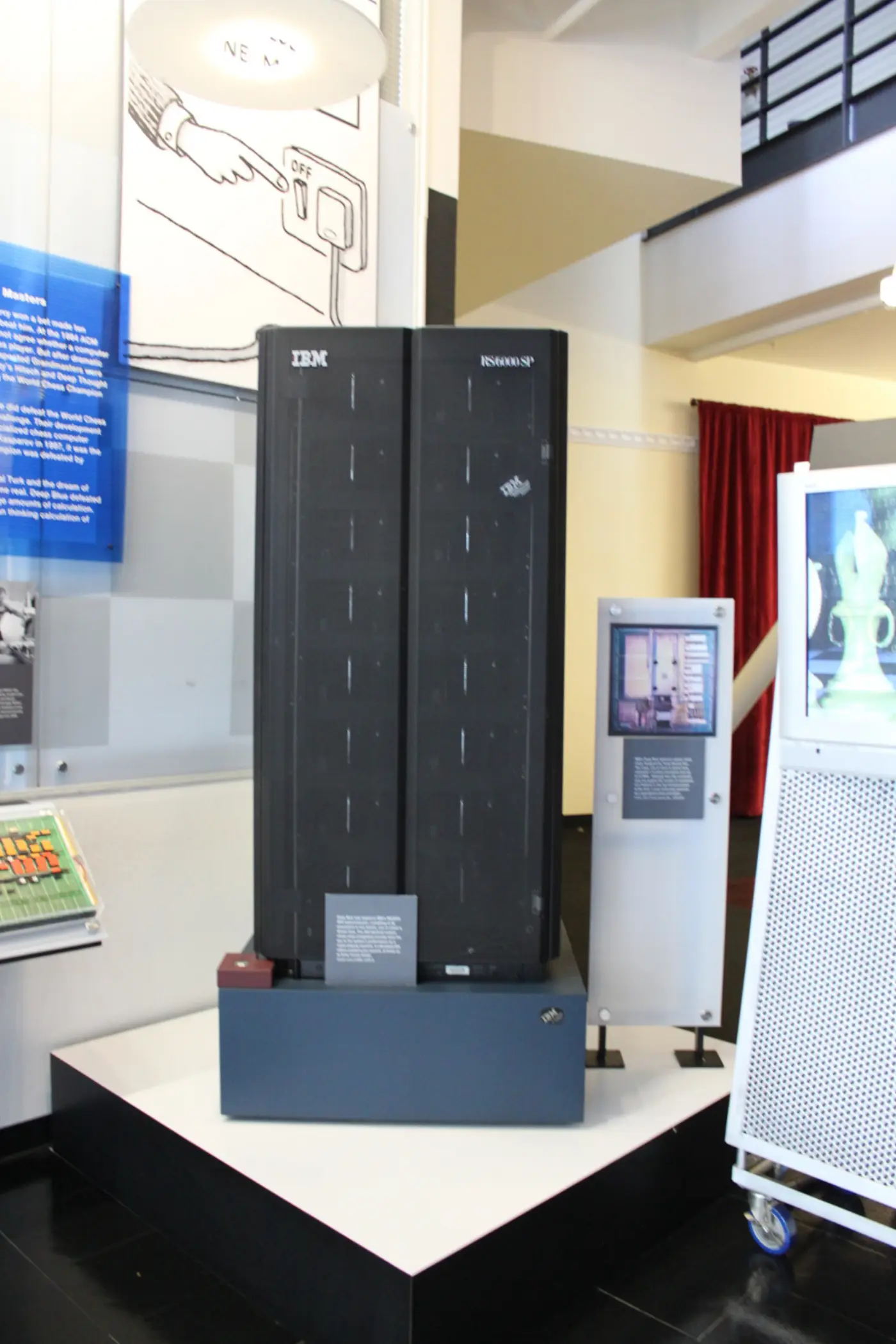
IBM Deep Blue on display at the Computer History Museum, the machine that beat the world chess champion in May 1997 · Anton Chiang from Cupertino, CA, USA · CC BY 2.0 · Wikimedia Commons
2012: Machines Learn to See
The next turn came from learning rather than calculation. In 2012, Alex Krizhevsky, Ilya Sutskever, and Geoffrey Hinton of the University of Toronto trained a deep convolutional neural network on 1.2 million ImageNet photographs. The network had 60 million parameters and 650,000 neurons, and they used GPUs to make training faster. A variant of this model won the ILSVRC-2012 competition with a top-5 error rate of 15.3 percent. The second-best entry had an error rate of 26.2 percent.
On paper that is a gap of 10.9 percentage points, but its meaning is larger. It was the year when it became plainly visible that a machine could find the features of a cat on its own by looking at many photographs, without a person writing the rule "a cat has pointed ears." The technologies that find faces in photos, read medical images, and let cars recognize pedestrians today largely trace their roots to this approach.
March 2016: A Go Board in Seoul
From March 9 to 15, 2016, at the Four Seasons Hotel in Seoul, Google DeepMind's AlphaGo played five games against Lee Sedol, a 9-dan professional. AlphaGo won 4 to 1. Lee won the fourth game on March 13, and AlphaGo resigned that game. DeepMind explains that AlphaGo uses two neural networks: a policy network that chooses the next move and a value network that predicts who will win. AlphaGo first learned from thousands of games played by human experts, then played thousands of games against earlier versions of itself and learned from its own errors.
AlphaGo added learning to calculation, and after learning from people it went on learning without them. I think what made this match special in Korea was less the result than the fact that so many people watched the machine's moves live and felt, for the first time, what a machine could do. And the fourth game showed, at the same time, that a machine can also be wrong.
A Blueprint in 2017, a Chat Window in 2022
In June 2017, researchers at Google released a paper titled "Attention Is All You Need." It proposed the Transformer, an architecture that drops recurrence and convolutions entirely and processes sentences using only a mechanism called attention. On the English-to-German translation benchmark it scored 28.4 BLEU, more than 2 BLEU above the previous best results, and a single model trained for 3.5 days on eight GPUs reached 41.8 BLEU on English-to-French. This architecture became the foundation of the language models that followed.
On November 30, 2022, OpenAI released ChatGPT as a "research preview." OpenAI stated that the model was fine-tuned for dialogue from the GPT-3.5 series, which had finished training in early 2022, and that it was trained with reinforcement learning from human feedback (RLHF). In the same announcement, OpenAI listed limitations: the model sometimes writes answers that sound plausible but are incorrect or nonsensical, its answers can change when the same question is rephrased slightly, and it can respond to harmful instructions. After this release, conversational AI became an everyday tool outside the laboratory.
I think that list of limitations is the most important part of the announcement. The party releasing the tool wrote down how the tool fails. It is like a hammer's manual noting that it can strike a finger instead of a nail head. Whether the user reads that line is what decides the outcome.
Where It Helped People, Part 1: The Shapes of 200 Million Proteins
If the history of progress had left behind only games and conversations, I would not be writing this piece. In 2020, Demis Hassabis and John Jumper of DeepMind presented AlphaFold2, a model that predicts the three-dimensional structure of a protein from its amino acid sequence. Researchers had been trying to solve this problem since the 1970s. In July 2021, DeepMind and the European Molecular Biology Laboratory's European Bioinformatics Institute (EMBL-EBI) opened a public database with more than 350,000 predicted structures, and in July 2022 they expanded it to more than 200 million, covering the proteins of almost every organism whose genome has been sequenced. The structures are free to use under a CC BY 4.0 licence. At the time of the expansion, more than 500,000 researchers from over 190 countries had used the database, and more than 1,000 scientific papers had cited it in just over a year.
On October 9, 2024, the Royal Swedish Academy of Sciences announced that half of the Nobel Prize in Chemistry would go to Hassabis and Jumper "for protein structure prediction" and the other half to David Baker "for computational protein design." The announcement stated that AlphaFold2 had predicted the structures of virtually all of the roughly 200 million proteins that researchers have identified, that more than two million people from 190 countries had used it, and that it was being used to better understand antibiotic resistance and to create images of enzymes that can break down plastic.
What makes this case special to me is that the tool gave a map, not an answer. Knowing a protein's structure does not produce a medicine on its own. But when the shapes that had been determined one at a time by experiment for fifty years are laid out 200 million at once, researchers can decide far more quickly where to dig. A good tool moves the starting line forward rather than doing the work for you.
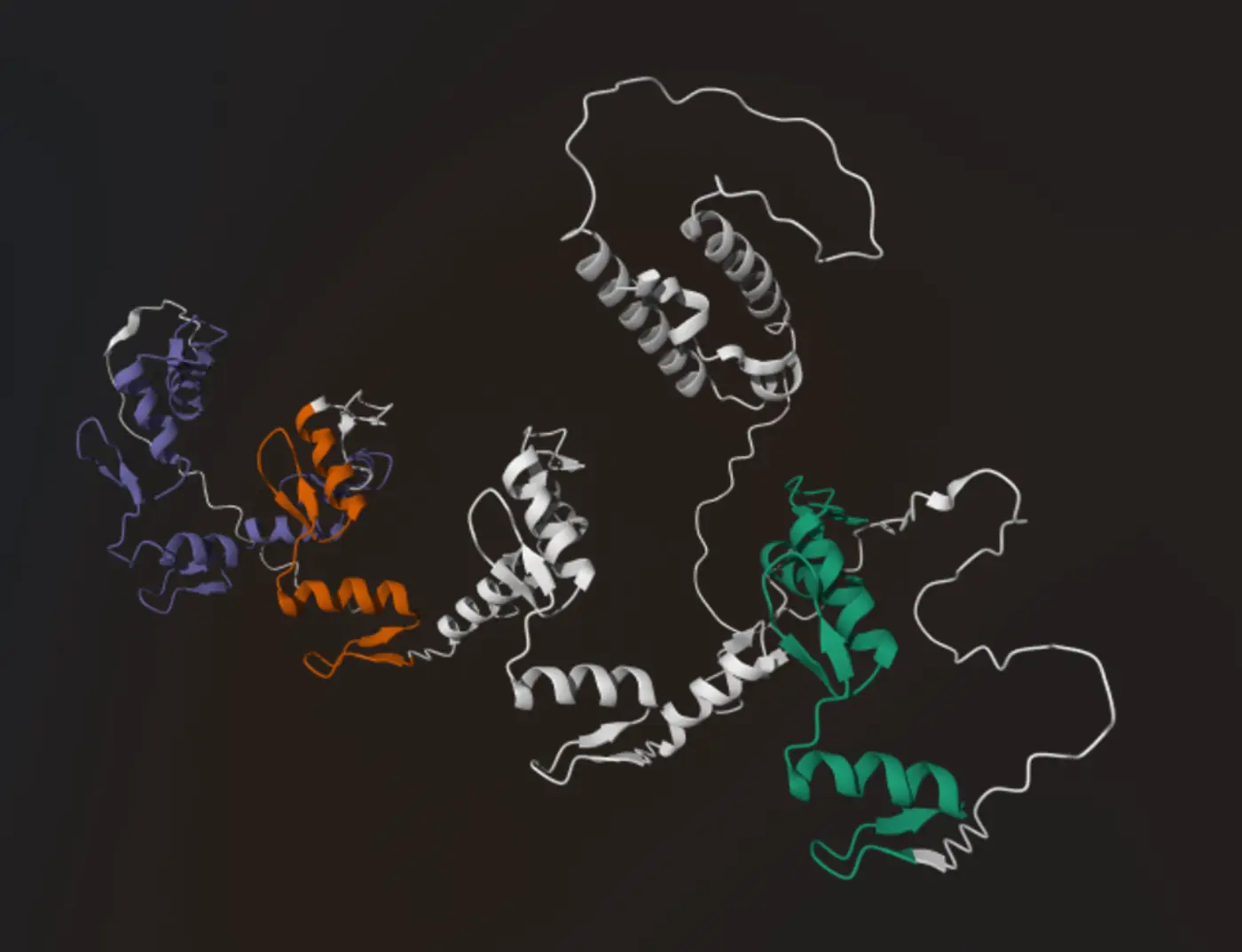
The predicted 3D structure of the human protein ZNF555 from the AlphaFold Protein Structure Database, drawn by computation rather than experiment · AlphaFold Protein Structure Database (DeepMind / EMBL-EBI) · CC BY 4.0 · Wikimedia Commons
Where It Helped People, Part 2: An Eye Screening with No Specialist in the Room
On April 11, 2018, the U.S. Food and Drug Administration (FDA) permitted the marketing of a software program called IDx-DR. An artificial intelligence algorithm analyzes images of a diabetic patient's retina and returns one of two results: if more than mild diabetic retinopathy is detected, "refer to an eye care professional"; if not, "rescreen in 12 months." The FDA stated that this was the first device authorized for marketing that provides a screening decision without the need for a clinician to also interpret the image or results, which makes it usable by health care providers who are not normally involved in eye care. The clinical study the FDA reviewed used retinal images from 900 patients with diabetes at 10 primary care sites. The device correctly identified patients with more than mild disease 87.4 percent of the time and correctly identified those without it 89.5 percent of the time.
The FDA announcement also notes that about half of patients with diabetes do not see their eye doctor on a yearly basis. I think the value of this tool lies in that sentence more than in the accuracy figures. It made it possible to look at the eyes of people who do not go to an eye doctor, in a place that is not an eye clinic. At the same time, the FDA wrote at length about when the device should not be used: not for patients who are pregnant, not for those who have already had eye treatment, not for those with certain other retinal conditions, and patients still need a complete eye examination at ages 40 and 60. The use of the tool and the places where it must not be used were written side by side in the same document.
The Stone Age Hand Axe and Today's Tool
According to the Smithsonian National Museum of Natural History's Human Origins resources, early humans were making stone tools by at least 2.6 million years ago. The oldest toolkit, the Oldowan, consists of hammerstones, stone cores bearing the scars of struck-off flakes, and sharp flakes. By about 1.76 million years ago, handaxes appeared, made by striking a large flake and then shaping it with smaller flakes; this Acheulean toolkit remained in use until roughly 400,000 to 250,000 years ago, depending on the region. Stones of similar shape were made for well over a million years.
The hand axe was neither good nor bad in itself. What the same stone did on the same day was decided not by the stone but by the hand. I read artificial intelligence along the same line. The question of 1950, the proposal of 1955, the rules of 1966, the calculation of 1997, the learning of 2012, the self-play of 2016, the blueprint of 2017, and the chat window of 2022 were all stages in shaping a new tool for the human hand. The map of 200 million proteins and the eye screening in the doctor's office show what happens when that tool is used for a human purpose.
So the conclusion of this piece is not a prophecy about technology but a request to its users. A tool differs according to the purpose it is used for. The list of limitations OpenAI wrote about its own model and the restrictions the FDA wrote about the device are not confessions of defects; they are instructions for use. Reading the instructions and deciding the purpose is still a human task. Just as the hand that held a stone 2.6 million years ago did, the hand on the keyboard now decides what this tool will do.
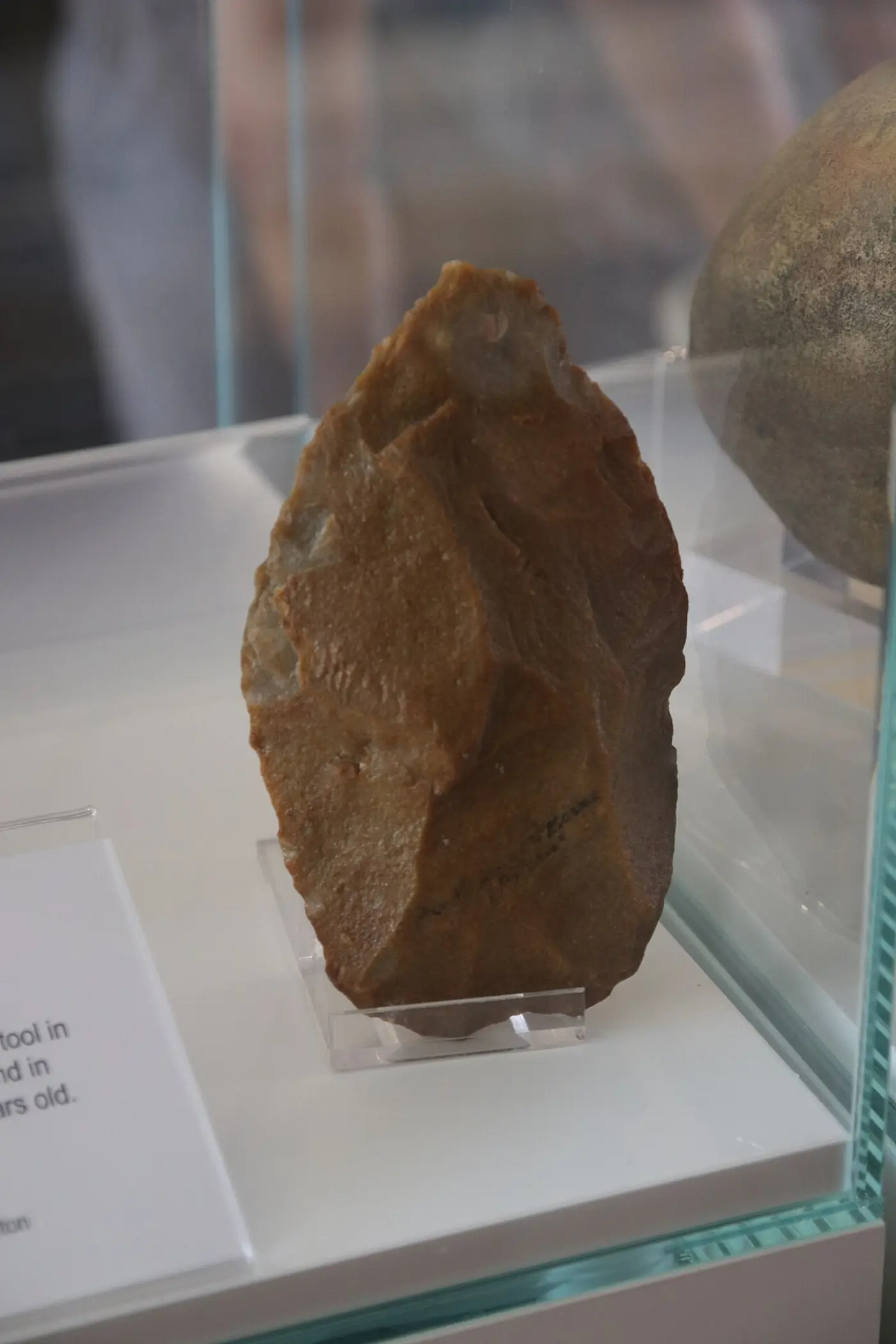
An Acheulean handaxe found in southern England, shaped by striking a large flake and then trimming its edges · Tim Sheerman-Chase · CC BY 4.0 · Wikimedia Commons